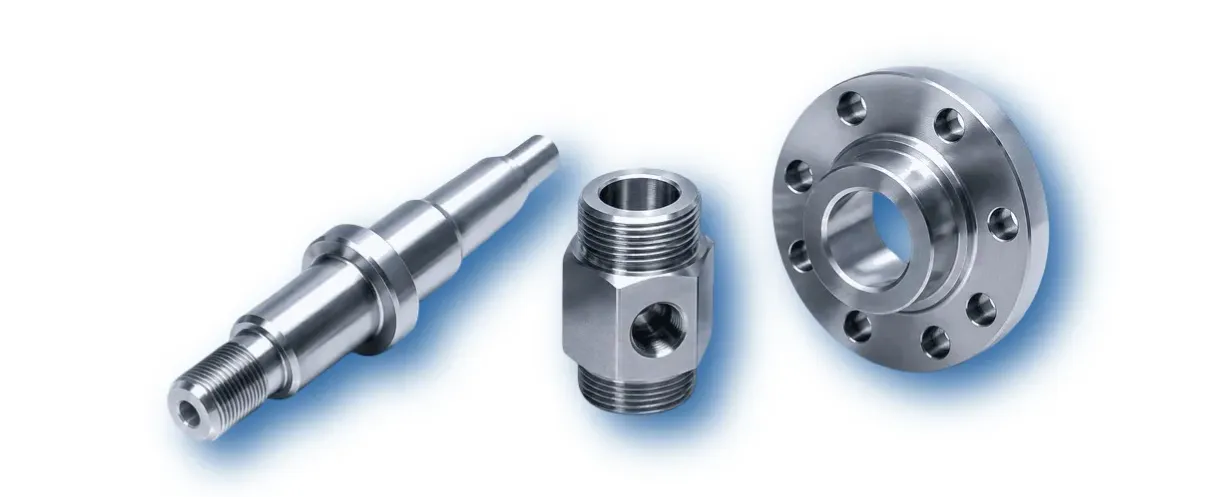
Stainless steel grade 1.4542 (17.4PH or AISI 630) is a martensitic precipitation hardening steel grade. It offers great strength and hardness along with great corrosion resistance. These wide range of characteristics can be summarized as follows: Good corrosion resistance, high strength and hardness, good machinability, good weldability, magnetic. This precipitation hardening steel grade can be used for aircraft fittings, valve parts, chemical process equipment, gears.
| EUROPE | ITALY | GERMANY | FRANCE | UK | USA | |||
|---|---|---|---|---|---|---|---|---|
| EN 10088-3: 2005 EN 10263-5: 2001 EN 10272: 2007 |
|
|
|
AISI | AMS | |||
| Grade | N° | Werkstoff | N° | |||||
| X5CrNiCuNb16-4 | 1.4542 | AISI 630 | AMS 5643 | |||||
| 17-4PH | AMS 5648 | |||||||
| C | Si | Mn | P | S | Cr | Ni | Cu | Nb | |
|---|---|---|---|---|---|---|---|---|---|
| Min | 15,00 | 3,00 | 3,00 | 0,15 | |||||
| Max | 0,07 | 1,00 | 1,00 | 0,040 | 0,030 | 17,50 | 5,00 | 5,00 | 0,45 |
These are the typical values of some physical properties for a steel AISI 630:
| Property | 20ºC | Up to 100ºC | Up to 200ºC | Up to 300ºC |
|---|---|---|---|---|
| Density (g/cm3 ) | 7,8 | |||
| Modulus of Elasticity (GPa) | 200 | 195 | 185 | 175 |
| Coef. Of thermal expansion (x10-6/ºC) | 10,9 | 11,1 | ||
| Thermal Conductivity W/mºC | 16 | |||
| Thermal Capacity J/KgºC | 500 | |||
| Electrical Resistivity mm2/m | 0,71 |
This quality has a general corrosion resistance compared with common martensitic steel grades.
The pitting corrosion resistance is given basically by the chromium and molybdenum content. A parameter used to compare the pitting corrosion resistance of different grades is the number PRE [Pitting Resistance Equivalent] which is defined as follows:
PRE=%Cr + 3,3*%Mo+16*%N
The higher this parameter is, the better the pitting corrosion resistance of the steel.
| AISI 410 | AISI420 (A) | AISI 630 | |
|---|---|---|---|
| PRE | 12 | 12 | 15 |
Martensitic steels are generally susceptible to stress corrosion cracking. For applications requiring high stress corrosion cracking, Duplex steels such as 1.4362 and 1.4462 are more suitable.
In certain processes or high temperature applications, precipitation of chromium carbides at the grain’s boundaries may happen. This Chromium is shifted from the matrix thus favouring intercrystallyne corrosion. The high C content of this grade favours the Chromium carbide precipitation and thus the likelihood of intergranular corrosion increases.
The mechanical properties at room temperature for this martensitic stainless grade AISI 630 are given according to American Standards ASTM A564. The most common conditions are annealed (A), or aged hardened as H1150 or H1150D.
Martensitic precipitation hardening stainless steels have acceptable aptitude to be worked by any manufacturing process as hot forming, cold forming, welding or machining. Different heat treatments can be applied in order to achieve the aimed mechanical properties. These heat treatments can either be an annealing process or a precipitation hardening process.
This AISI 630 grade can be used for welding. Due to the Cu content, it is required to perform a post welding treatment is required to ensure that the aimed mechanical properties are obtained both at the welding region and at the parent material.
The heat treatment for this steel varies depending on the desired final mechanical characteristics. Annealing process consists in heating up to 1025-1055°C followed by quenching. Aging heat treatments consist in a precipitation hardening that can be performed at different temperatures depending on the final goal properties. The lower the temperature, the higher the final hardness:
| Heat Treatment | Solution annealing | Hardening | |||
|---|---|---|---|---|---|
| Temperature (ºC) | Cooling | Temperature (ºC) | Holding min time | Cooling | |
| H900 | 1040 +/-15 | Air / Oil | 480 | 1h | Air |
| H1025 | 1040 +/-15 | Air / Oil | 185 | 4h | Air |
| H1150 | 1040 +/-15 | Air / Oil | 550 | ||
| H1150D | 1040 +/-15 | Air / Oil | 620 | 4h | Air |
The AISI 630 is suitable for machining operations but different parameters shall be used depending on the precipitation hardening treatment applied.
Phone
(0216) 593 04 74